
AI Won't Stop at Human Intelligence
Parity with human intelligence is just a milestone, not an endpoint.

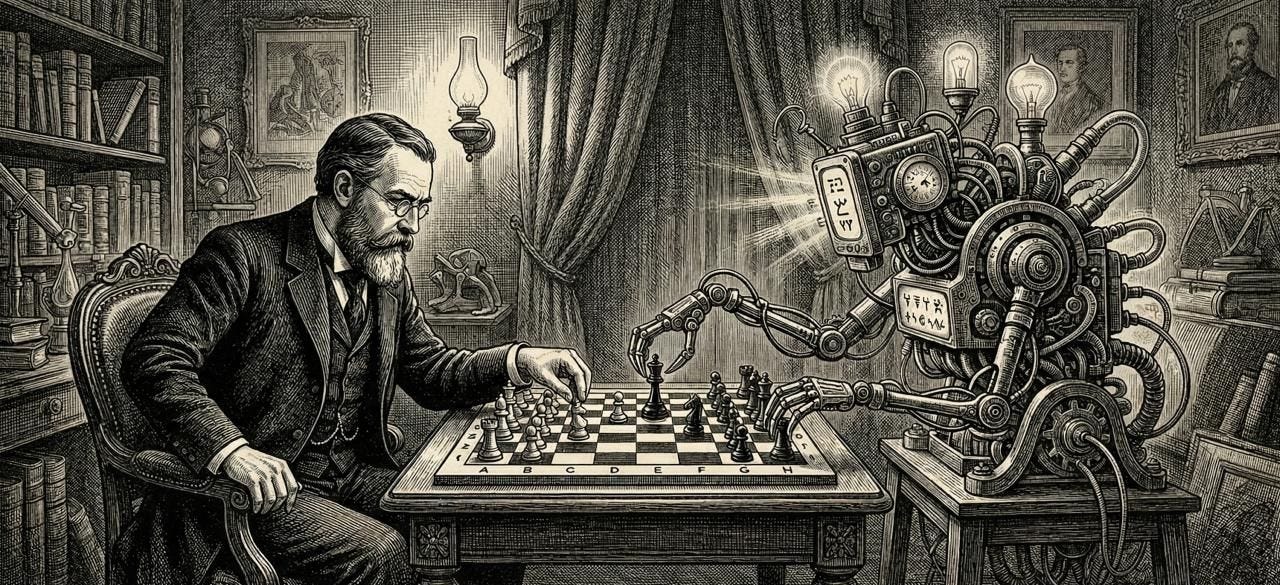
In 1997, Garry Kasparov sat across from IBM’s Deep Blue. The world’s greatest chess player facing the world’s best computer.
As Kasparov watched, the machine made a move he simply couldn’t understand. Not a strong move, necessarily. But a very strange one. It sent Kasparov into a spiral of self-doubt: what was the computer planning? What did the computer see that he couldn’t? Kasparov lost the match. He revealed years later in his book that Deep Blue’s strange move was a software bug. But the damage was done. The mere appearance of human-like intelligence was enough to rattle and defeat the grandmaster.
But human-like intelligence, whether real or perceived, is not a destination. It is merely a notable milestone. Why would AI stop there? There is no reason why AI intelligence will stop once it achieves parity with humans, and several compelling reasons why it will accelerate past us.
The tipping point
I was an early adopter of vibe coding, and it was a fun toy. A toy that didn’t work most of the time, but the potential was obvious. Contrary to the claims of the WordPress community, code isn’t poetry. It is a repeatable language structure with recognisable patterns. And AI is the most formidable pattern-matching machine that has ever existed. Its ability has caught up with humans quickly: today, fifty per cent of Google’s code is written by AI. One hundred per cent of Claude Code is created by AI.
We are watching Deep Thought create the Earth.
A hundred years ago, Jacob Riis advised us to “look at a stonecutter hammering away at his rock, perhaps a hundred times without as much as a crack showing in it. Yet at the hundred and first blow it will split in two, and I know it was not that last blow that did it, but all that had gone before.” That is the tipping point. It was so easy to dismiss vibe coding slop in the early days — simple errors, repeating lines, non-functioning apps. But no longer. Like the stonecutter’s rock, code has been cracked. Boris Cherny, the creator of Claude Code, now feels that “coding is largely solved”. Those early hammer blows have compounded.
AI companies are sinking huge investments into perfecting AI code generation, but they are not stopping at code. Code is just a language, like English or Hindi. It’s all just patterns. Billions of potential combinations and data points, but finite. Law, medicine, analysis, writing, all sit on the same curve. Engineers are caught in the first wave of a tsunami that is coming for everyone. No one is safe.
Code is just a language pattern. But so is poetry.
Beyond human imagination
Twenty years after Deep Blue defeated a chess grandmaster, DeepMind’s AlphaGo defeated Lee Sedol, one of the strongest Go players alive. AlphaGo made a move no human had conceived of in two and a half thousand years of play. Lee was so taken aback that he stood up and left the room. “After humanity spent thousands of years improving our tactics”, Rick Rubin wrote in The Creative Act, “computers tell us that humans are completely wrong.”
Human intelligence is a false ceiling. AI doesn’t share our limitations. It can see patterns we have never seen, hold vast amounts of evidence at scales no person could carry in their head, and make moves we cannot conceive of.
Research from Caltech found that whilst our senses can gather data at a billion bits per second, we can only process information at a mere ten bits per second. All human interfaces and software are designed for our human limitations and our ability to process only 0.000001% of the incoming data. These limitations seem absurd when compared to AI. Soon, measuring AI against human performance may seem as quaint as measuring a jet engine against a horse.
An alien intelligence
AI is an alien intelligence, one that will, according to Yuval Noah Harari, “make alien decisions and generate alien ideas, decisions and ideas that are unlikely to occur to humans.” For better or worse, these systems are completely free of the physical constraints, ego, emotions and insecurities that bind every human mind.
Ryan McClelland, an engineer at NASA, described working with AI-designed spaceship parts as “collaborating with an alien.” The AI produced components a third of the mass, stiffer, stronger, and lighter. “It comes up with things that not only we wouldn’t think of, but we wouldn’t be able to model even if we did.”
Kasparov himself understood the alien nature of AI. “Airplanes don’t flap their wings,” he wrote, “and helicopters don’t need wings at all. So why should computer brains work like human brains in order to achieve results?” Machines surpass our results by abandoning our methods.
AI exists in a realm no human could ever exist in. And conversely, AI can only ever approximate a picture of the world as we experience it.
The scarcity collapse
AI is changing access to skills incredibly quickly. In the web development industry, we have engineers on six-figure salaries because of the scarcity and demand for their skills. But that scarcity is fast disappearing. AI is making technical skills instantly available to all. Why pay a software engineer hundreds of thousands of dollars if someone can vibe code a passable solution over a weekend?
As the business parable goes, an engineer fixed a factory’s broken production line by tightening a single screw. When his large invoice arrived, the furious owner demanded an explanation. “I charged you $1 for tightening the screw,” the engineer replied. “The rest is for knowing which screw to tighten.”
The declining value of skills
But skills have suddenly become devalued many times in history. In 1785, Edmund Cartwright’s power loom allowed a single child to produce as much fabric as three and a half skilled, traditional weavers. Mechanisation halved weavers’ wages over the following years. 19th Century hand-weavers would have a lot to tell today’s software engineers. Spoiler alert: unless you’re the factory owner, it doesn’t end well.
AI is becoming the great leveller. Ethan Mollick’s research at Wharton shows that below-average workers using AI can already match top-tier professionals. The value of accumulated years of experience is collapsing. Like the machines of the industrial age, AI is rapidly removing the value of hard-earned skills and experience. As it replaces our skills, all we’ll have left is our labour.
Like Kasparov, we may not be able to tell the difference between real and perceived intelligence.
It may already have exceeded our intelligence. We’re just not smart enough to notice.